Sound

Music, Sound Design, Sound Art, and Video

In Out Festival of Digital Performance, New York, September 2010

My project Ostracon (John Keston and Graham O’Brien) was accepted and performed at the In/Out Festival of Digital Performance in New York, September, 2010. Ostracon performs generative, improvisational compositions using my custom software, the GMS (Gestural Music Sequencer), that converts video input into musical phrases. I capture, layer, loop and process melodic segments in real-time out of the stream of notes created by my gestural input, and tailor them with probability distribution algorithms. O’Brien accompanies these angular, electronic structures, with dynamic playing that, at times, verges on the chaotic.

The lineup this year included Monome creator, tehn (Brian Crabtree), and Peter Kirn of Creative Digital Music. From the In/Out Festival website.

In/Out is an annual festival that features leading performers, developers, artists, and tinkerers of the digital design community in hopes bridging the gap between the forum based world and the stage. The festival seeks to bring digitally driven performances into the limelight with two full days of workshops and performances.

This video above is a live studio piece shot by Ai student Josh Clos, and recorded at Ai Minnesota by John Keston and Graham O’Brien. It’s representative of the music that we are generating during our live performances. For more visit the Ostracon tag on AudioCookbook.org, or visit Unearthed Music.
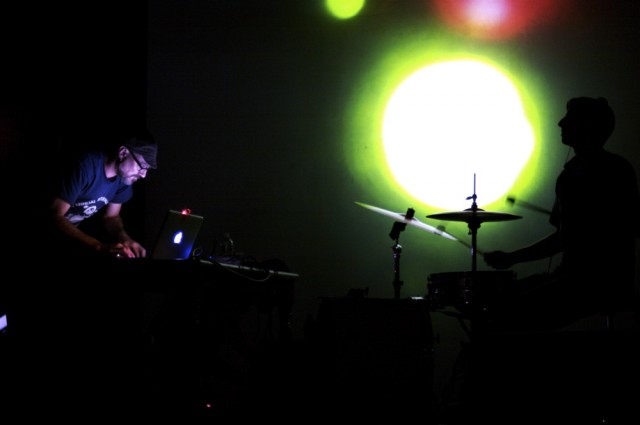

Ostracon at the In / Out Festival of Digital Performance.
Chromatic Textures Shown at 6X6 #5: Mystery

On Wednesday, July 7, 2010 my piece Chromatic Textures was shown at 6X6 #5: Mystery, an exhibition at CinĂ© Lab in Athens, Georgia. My work was accepted along with five other artists, “…including Denton Crawford’s eyeballs, Aaron Oldenburg’s plunge into asphyxia, and a performance streamed live over the Internet from California.” Here’s my abstract for Chromatic Textures.

Chromatic Textures is a study on the synesthetic nature of our senses of sound and sight. Video input is used to produce generative musical phrases. The visual media is analyzed by the GMS (Gestural Music Sequencer) to create the musical forms in real-time. The software includes adjustable probability distribution maps for the scale and rhythm. Adjusting these settings allows familiar structures to emerge. The settings chosen for this piece cause notes within a particular scale to play more frequently, however, it is still possible for any note within the twelve-tone chromatic system to occur. As a result, dissonant or blue notes can be heard at rare instances throughout the piece.
Continue reading

Five Movements for Five Sampled Sounds in Five Loud Speakers

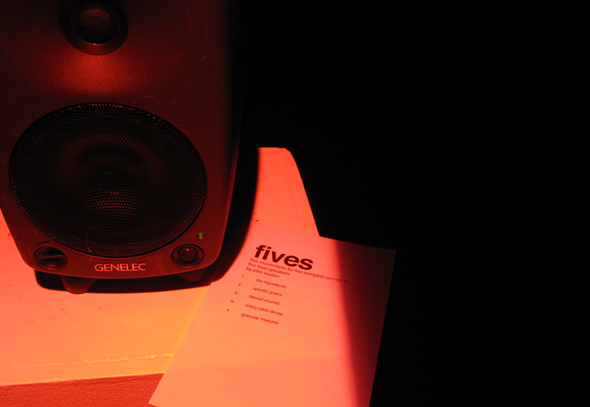
fives

On Tuesday, December 7, 2009 I presented a sound art installation titled, Fives, at the University of Minnesota. The subtitle of the work is, Five Movements for Five Sampled Sounds in Five Loud Speakers. To produce the sound for the work I developed an instrument designed to explore granular interpretations of digitized waveforms. The instrument was controlled over a wireless network with a multi-touch device. The sound objects generated were amplified through five distinct loud speakers arranged on pedestals at about chest height in a pentagonal configuration.
Continue reading

Forgotten Complex

This piece, titled Forgotten Complex, was originally exhibited on audiocookbook.org and came about as a side effect of my contributions to the One Sound Every Day project. Rather than a percussion driven piece, Forgotten Complex relies on ambient Rhodes and other processed sound effects to create the lonely atmosphere of an abandoned warehouse. The piece is included on my solo album, Precambrian Resonance by Ostraka (Unearthed Music, 2009).

Forgotten Complex:

Chromatic Currents II

This second part to “Chromatic Currents” was produced with the GMS by using a string of lights placed into a large glass vase. I moved the camera around the vase to direct the flow of musical phrases with one hand while I adjusted transposition and note duration settings in the sequencer with my right.

You might notice that the video stimulus does not resemble lights in a vase. This is because I applied a negative filter to the video after capturing the performance. I used a pentatonic scale interspersed with rare dissonant notes and probability distributions in the note durations to give it an eerie awkwardness.

GMS: Chromatic Currents Part II from Unearthed Music on Vimeo.