On November 27, 2012 I made a binaural recording of David Byrne’s installation, Playing the Building (2012), at Aria in Minneapolis. During my session in the space I recorded a solo performance of myself, a duet with me and Jon Davis on bass clarinet, and a trio (DKO) with me, Graham O’Brien on drums and Jon Davis. I used a binaural head to record each performance. I have been interested in building a binaural head for some time, and finally got the parts together including a mannequin head, silicone ears, and overhead microphones capsules. I’ll share more about “Vincent” (the head’s name), and the rest of the recordings soon. For now here’s a video of my solo performance. Remember to listen using headphones in order to hear the binaural spatial effects. You’ll hear the installation surrounding you, a visitor bouncing a tennis ball off to the right, and occasional interjections of people in conversation.
Sound
Music, Sound Design, Sound Art, and Video
Northern Spark In Habit: Living Patterns
Recently I have been working on an eight channel, spatialized sound, projection, and dance collaboration. I composed the music entirely using my collection of analog synthesizers. I also designed an octal sound system (eight discrete channels) to spatialize the music and sounds. The performances are Thursday, June 7 at 9pm, Friday, June 8 at 9pm and Saturday, June 9th from 9pm until 6am (yes that is 9 long hours). Checkout In Habit: Living Patterns for the location and other details.
Here’s how I am processing the music for spatialization. The outdoor stage is a raised 18′ x 18′ square that the audience can view from any angle. At each corner I have outward facing wedges to project sound toward the audience. Behind the audience I have inward facing speakers on stands, also at each corner of the venue (a public space under the 3rd bridge in Minneapolis).
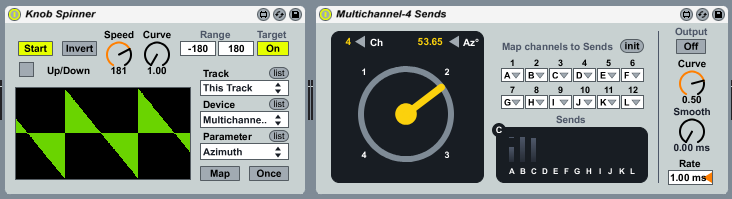
Using a Max for Live patch that I developed and another that is part of the M4L toolset I am able to rotate sounds around the system in many ways. This includes clockwise and/or anti-clockwise at variable frequencies around the outer or inner quads or both. I can also pan sound between the inner and outer quads with or without the rotation happening simultaneously. Quick adjustments allow me to create cross pans to for sweeping diagonals and so on. I originally thought I could do this with one of many M4L LFOs, but found out this would be impossible. In a future post I will explain why I had to develop my own patch to do this. For now, please enjoy a sadly two channel rough mix of Kolum, the second in the series of sixteen vignettes, and come to the performance to hear it in all of its spatialized, eight channel glory.
Video: Duet for Synthesizer and the Washing
Note: This video was produced with binaural sound. Please listen with headphones to experience the binaural effect.
In this “duet” I am using the Korg Monotribe to join in with the laundromat ambience as if it were a conscious participant in an improvisational ensemble. The activity in the space produced oscillations that caused sound waves forming drones and rhythmic patterns. I responded with basic oscillators like pulse, saw, or triangle waves. I manipulated the filter, LFO and pitch to create more complex textures that alternately blend and contrast with the ambient sound.
The ambience was recorded with a set of binaural microphones. When wearing stereo headphones the playback of a binaural recording accurately positions the direction of each sound for the listener, immersing them in the spatial soundscape. In contrast the synthesis was recorded in mono, without additional processing. This simulates a process called phonomnesis, or imagined sound, by placing the signal in the center of the listeners sound-space.
Midnight Playground
Midnight Playground is an interactive, kinetic, installation by Peng Wu, Jack Pavlik, John Keston, and Analaura Juarez. Peng initiated and directed the idea, Jack built the jump rope robot, and Annalaura helped refine the concept and promote the piece. My role was to produce the music and track it to the still images that Peng had selected. I ended up making a one hour video with thirty minutes of the image from the moon followed by a four second transition into another thirty minutes with an image of Mars. To produce the sound I gave Peng a list of audio excerpts that had all been previously posted on AudioCookbook in One Synthesizer Sound Every Day. He picked the two that he thought would work the best and I went back to my original recordings and processed them specifically for the piece by adding some reverb and delay to enhance the spatial properties of the music. The piece will be on display in Gallery 148 at the Minneapolis College of Art and Design through January 29, 2012.
Voice Lessons
Voice Lessons is an electronic, audio device that interrogates the popular myth that every musical instrument imitates the human voice. Touching the screen allows the participant to manipulate the visuals and vocalizations of the “voice teacher” as he recites vocal warm up exercises.
The piece resides in the space between a musical instrument and voice lesson. Move the touch point left, right, up, and down to explore the visual and auditory possibilities. Rapid high pitched loops occur while touching near the top of the screen while lower pitched longer loops are heard near the bottom.
The actor, also named John Keston, is the artist’s retired father who became a voice teacher after a long career on stage in plays, operas, and musicals with the Royal Shakespeare Company in his native country England and abroad.
Voice Lessons
32” interactive touch screen installation
2011
Continue reading