On November 27, 2012 I made a binaural recording of David Byrne’s installation, Playing the Building (2012), at Aria in Minneapolis. During my session in the space I recorded a solo performance of myself, a duet with me and Jon Davis on bass clarinet, and a trio (DKO) with me, Graham O’Brien on drums and Jon Davis. I used a binaural head to record each performance. I have been interested in building a binaural head for some time, and finally got the parts together including a mannequin head, silicone ears, and overhead microphones capsules. I’ll share more about “Vincent” (the head’s name), and the rest of the recordings soon. For now here’s a video of my solo performance. Remember to listen using headphones in order to hear the binaural spatial effects. You’ll hear the installation surrounding you, a visitor bouncing a tennis ball off to the right, and occasional interjections of people in conversation.
News
Events, Articles, Performances, and Exhibitions
Time-lapse of In Habit: Living Patterns
This video created by Caleb Coppock illustrates the time scope (from dusk until dawn) of the In Habit: Living Patterns performance at Northern Spark, June 2012. I composed the music for the sixteenth and final vignette in the sequence titled, Energy and then adapted it for the time-lapse sequence.
Keep an eye/ear out for upcoming documentation that will display the dance movements in real-time. I also have some video with binaural audio recorded at one of the performances that I will be sharing as well.
Eyeo: Using Digital Imagery to Generate Sound
The first ever Eyeo Festival was last June and the second iteration looks to be just as amazing as the last. Here’s a video of a presentation that I gave at Eyeo last year on using digital imagery to generate sound. I also have the HTML5 slideshow available (use the left and right arrow keys to navigate). A big thanks goes out to Dave Schroeder for creating Eyeo and sharing these videos.
In Out Festival of Digital Performance, New York, September 2010
My project Ostracon (John Keston and Graham O’Brien) was accepted and performed at the In/Out Festival of Digital Performance in New York, September, 2010. Ostracon performs generative, improvisational compositions using my custom software, the GMS (Gestural Music Sequencer), that converts video input into musical phrases. I capture, layer, loop and process melodic segments in real-time out of the stream of notes created by my gestural input, and tailor them with probability distribution algorithms. O’Brien accompanies these angular, electronic structures, with dynamic playing that, at times, verges on the chaotic.
The lineup this year included Monome creator, tehn (Brian Crabtree), and Peter Kirn of Creative Digital Music. From the In/Out Festival website.
In/Out is an annual festival that features leading performers, developers, artists, and tinkerers of the digital design community in hopes bridging the gap between the forum based world and the stage. The festival seeks to bring digitally driven performances into the limelight with two full days of workshops and performances.
This video above is a live studio piece shot by Ai student Josh Clos, and recorded at Ai Minnesota by John Keston and Graham O’Brien. It’s representative of the music that we are generating during our live performances. For more visit the Ostracon tag on AudioCookbook.org, or visit Unearthed Music.
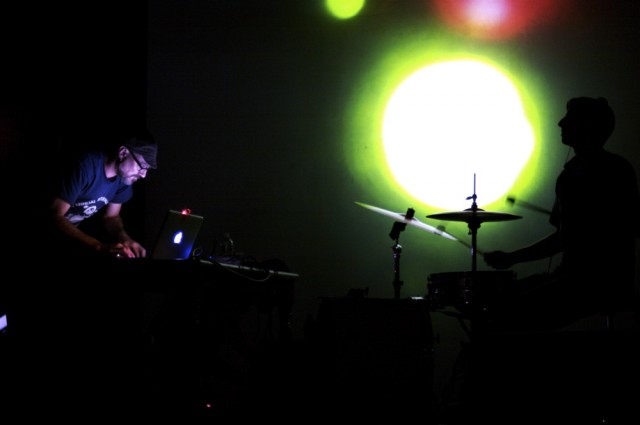
Ostracon at the In / Out Festival of Digital Performance.
Chromatic Textures Shown at 6X6 #5: Mystery
On Wednesday, July 7, 2010 my piece Chromatic Textures was shown at 6X6 #5: Mystery, an exhibition at Ciné Lab in Athens, Georgia. My work was accepted along with five other artists, “…including Denton Crawford’s eyeballs, Aaron Oldenburg’s plunge into asphyxia, and a performance streamed live over the Internet from California.” Here’s my abstract for Chromatic Textures.
Chromatic Textures is a study on the synesthetic nature of our senses of sound and sight. Video input is used to produce generative musical phrases. The visual media is analyzed by the GMS (Gestural Music Sequencer) to create the musical forms in real-time. The software includes adjustable probability distribution maps for the scale and rhythm. Adjusting these settings allows familiar structures to emerge. The settings chosen for this piece cause notes within a particular scale to play more frequently, however, it is still possible for any note within the twelve-tone chromatic system to occur. As a result, dissonant or blue notes can be heard at rare instances throughout the piece.
Continue reading