Machine Machine (2013) is a 32″ touchscreen installation that functions as an electronic instrument. Granular synthesis is used to loop “grains” of sound and video at variable lengths and frequencies. These parameters are based on the y-axis of the touch point on the monitor. The x-axis determines the position of the grain within the timeline. The piece was exhibited last month at the Northrup King Building in Minneapolis during Art-a-Whirl and for Visual Storage; the MCAD MFA thesis exhibition.
Continue reading
Tag Archives: MaxMSP
Five Movements for Five Sampled Sounds in Five Loud Speakers
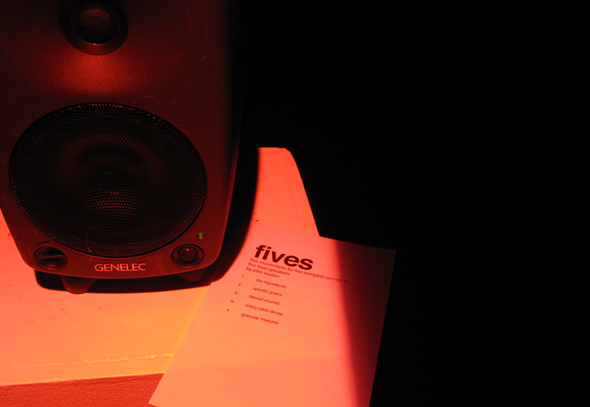
On Tuesday, December 7, 2009 I presented a sound art installation titled, Fives, at the University of Minnesota. The subtitle of the work is, Five Movements for Five Sampled Sounds in Five Loud Speakers. To produce the sound for the work I developed an instrument designed to explore granular interpretations of digitized waveforms. The instrument was controlled over a wireless network with a multi-touch device. The sound objects generated were amplified through five distinct loud speakers arranged on pedestals at about chest height in a pentagonal configuration.
Continue reading
Presentation at the Ableton Live Users Group
 I will be presenting and performing at the Minneapolis Ableton Live Users Group on December 8, 2009 at the Nomad in Minneapolis, Minnesota. In my presentation I’ll be showing what I do with custom built applications and Ableton Live, including the GMS and my new Wavetable Glitch Machine. Currently I interface my custom built applications with Live, using MIDI via the IAC drivers in Mac OS X, and Soundflower for audio. Soon I’ll be converting my audio based Max patches over to Max for Live, so I can use them in Live directly.
Also appearing is Ali Momeni who’ll be showing some of his Max for Live patches, and JP Hungelmann who also organizes the event. Last time the group met it was held at IPR and there was an excellent turn out. The speakers were terrific and they gave away Ableton demo discs and t-shirts at the end of the event. If you use Live, have any interest in it, or electronic music in general, I highly recommend attending.
Traversing Samples with Granular Synthesis
 This sound was generated using an instrument that I developed using MaxMSP tentatively titled the Wave Table Glitch Machine. The instrument uses TouchOSC as a controller running on an iPod Touch. I interfaced the accelerometer on the iPod to a filter so that when turned on with a toggle, tilting it on the y axis causes a lowpass filter to effect the sound. By setting a threshold on the z axis, giving the iPod Touch a brisk shake will cause the patch to loop a randomly selected grain of random length from a randomly selected buffer played back at a randomly selected rate. The variety of sounds possible with five short samples is expansive. Here’s a selection of sound produced with just one sample selected.
Etude in 8 Bits for Multitouch Graintable Synthesis: